The AWACA traverse is back on the move to carry out instrument maintenance!
The AWACA 2025–2026 scientific traverse has begun its journey across the ice for an important maintenance campaign on the instruments deployed last summer in Adélie Land, opposite the Dumont d’Urville station.
The teams are travelling between the various sites to carry out essential operations: checking system functionality, performing repairs, replacing sensors, and restoring power and data transmission systems, all of which are crucial to ensuring the continuity of measurements during the months of polar isolation.
The OPUs, autonomous observation platforms tested by extreme cold, katabatic winds, and rime ice, are undergoing thorough inspections: cleaning of optical components, checks of electronic systems, replacement of batteries, and repair or replacement of any damaged instruments.
These interventions aim to ensure a reliable resumption of data acquisition as soon as the end of the summer season.
This new traverse represents a key stage in the sustainability of the observation network, enabling the instruments to continue accurately documenting the evolution of the atmosphere and water in all its forms in one of the most hostile environments on Earth.
Removal of faulty instruments from the D17 weather tower
How does the atmospheric water cycle work in Antarctica?
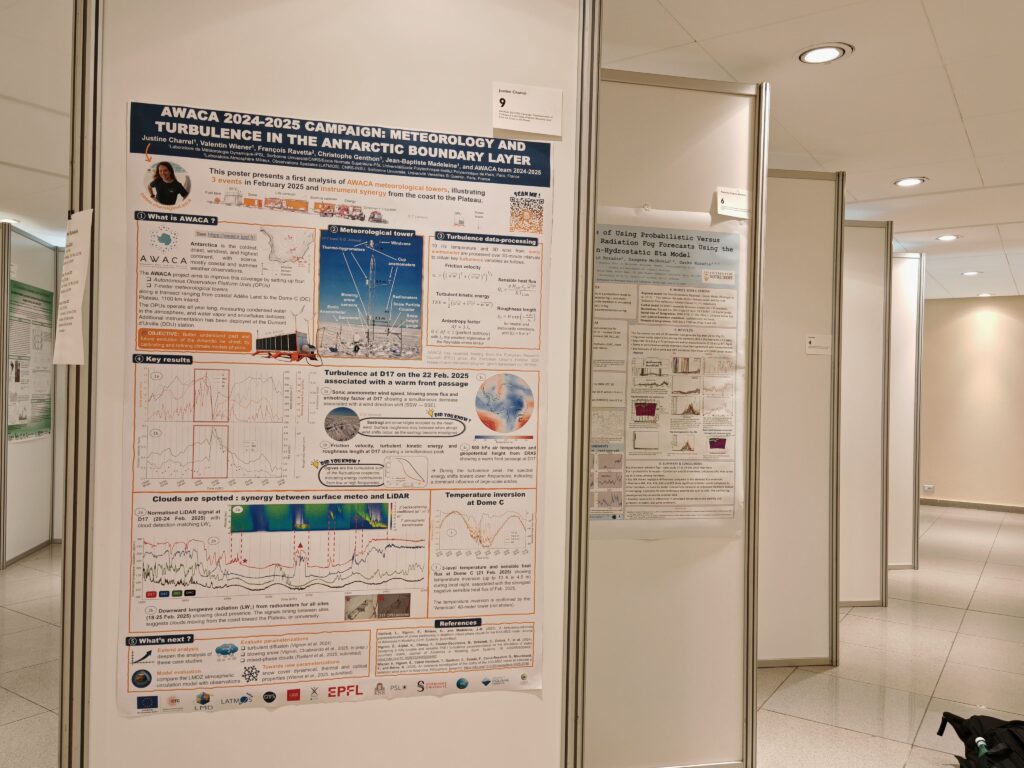
The AWACA project, funded by the European Union, will address this question, thereby improving our understanding of snow formation and snowfall in Antarctica, particularly from a quantitative perspective.
To understand and predict the pathways of atmospheric water, including isotopes, throughout the entire tropospheric column, the project will apply a coherent and comprehensive framework that combines observations and modelling.
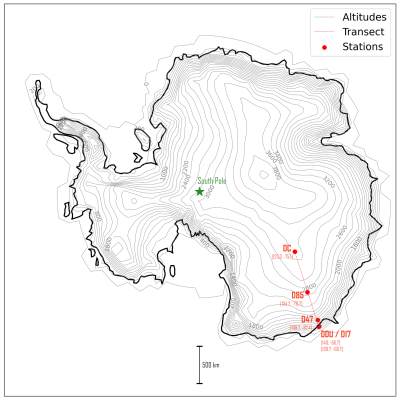
AWACA will also integrate adapted and specially designed instruments to form fully autonomous observation platforms deployed across multiple sites along a 1,100 km coast-to-plateau transect, aligned with typical trajectories of air masses transporting moisture.
The results will help scientists gain a better understanding of past, present, and future variability.